
Do families need 3 months of supplies? What's actually official
By ClearOutpost team · · 4 min read
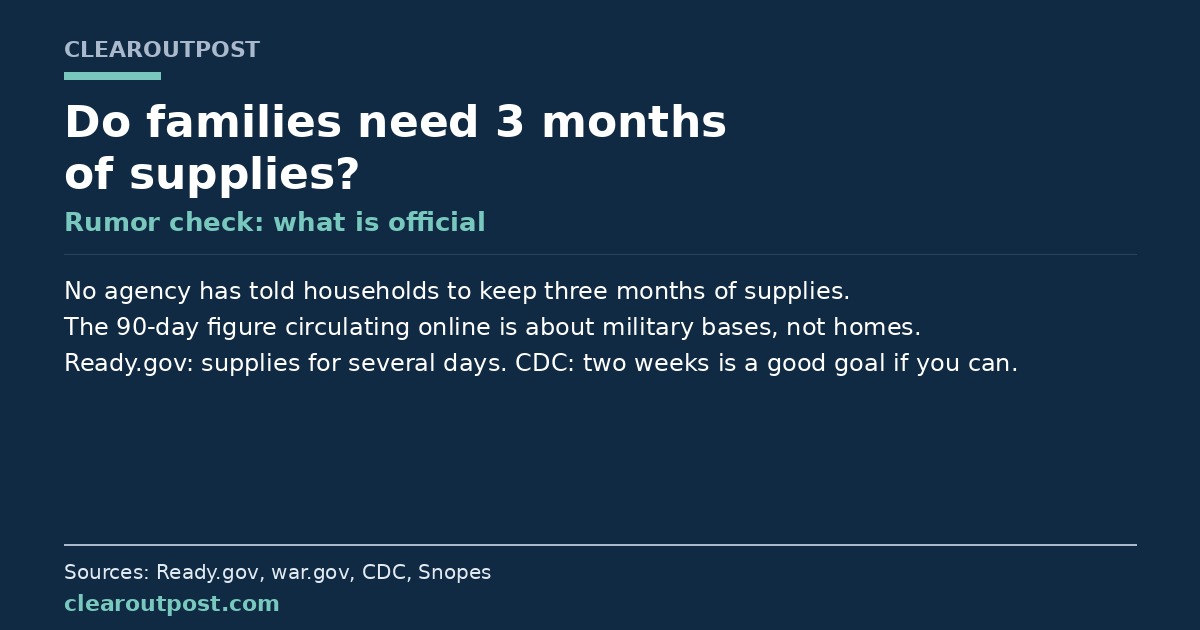
No federal agency has told American families to keep three months of emergency supplies at home. That claim has been spreading in posts and videos, often by treating a military-base program as household advice. The official guidance for families is more modest, and it is already published: Ready.gov tells households to gather supplies for several days, and the CDC says a two-week water supply is a good goal if you can.
The claim circulating online
Some posts say the Pentagon or the FBI instructed families to stock about 90 days, or three months, of food, water, and other supplies. A few versions point to a military preparedness program and present its numbers as a requirement for every household.
A claim can travel quickly when it sounds official and urgent. The useful response is not to repeat it as fact, and it is not to ignore preparedness. It is to read what agencies have actually published, then take one practical step that matches that guidance.
What official sources actually say
Ready.gov, the federal site for public emergency preparedness, has not told households to keep three months of supplies. Its Build A Kit page, last updated July 1, 2026, says that after an emergency you may need to get by on your own for several days, and that a kit should include food, water, and other basics to last for several days.
On water, Ready.gov recommends one gallon per person per day for several days, for drinking and sanitation. The Centers for Disease Control and Prevention gives the same daily amount and a clearer time goal: store at least one gallon per person per day for three days, and try to store a two-week supply if possible. That two-week figure comes from the CDC, not from a three-month household order.
A real Pentagon program is part of why the rumor spread, but it is not household guidance. On September 30, 2026, the secretary of defense announced FORTRESS America during a State of the Force address at Marine Corps Base Quantico. A department news report and a memorandum issued that day describe a program to help military installations eventually run on their own power, harden bases against intrusion, and bring critical supply chains home.
Later news reports described a 90-day self-sufficiency target for military bases. A Snopes review published October 26, 2026, found that FORTRESS is a real Department of Defense initiative, but that the specific 90-day operating requirement had not been confirmed in a public Pentagon statement. There is no official instruction from the Pentagon or the FBI telling families to keep three months of supplies. Even if a 90-day standard is used on military installations, that is a planning target for bases, not a kit list for homes.
If a post does not link to an official page, treat the number as unverified until you can read the source yourself.
A realistic goal for households
Start with the Ready.gov kit, then work toward two weeks of water and food if your space, budget, and household needs allow it. You do not have to match a military-base timeline to be better prepared. A few days of water and medicine already helps in a short outage. Building toward two weeks, at a pace you can afford, follows official civilian guidance.
Water is the first item to get right: one gallon per person per day, plus extra for pets and for very hot weather. Include prescription medicines, a battery-powered or hand-crank radio, a NOAA Weather Radio if you have one, flashlights, copies of key documents, and food that your household will actually eat. Ready.gov also recommends preparing a smaller kit for work and one for the car, because an emergency may not happen at home.
A simple two-week checklist
Use this as a household list, not as a rush order. Count what you already have, then add a little at a time. For a two-week water supply, plan on about 14 gallons per person, at one gallon per person per day.
- Water: one gallon per person per day, first for several days and then toward two weeks if you can
- Food that needs little or no cooking, plus a manual can opener
- Prescription medicines, a first-aid kit, and any medical devices you rely on
- A battery, solar, or hand-crank radio, a flashlight, and extra batteries
- Copies of IDs, insurance papers, and a short family communication plan
- Extra water and food for pets, and any supplies needed by children or older relatives
Check expiration dates once or twice a year and replace what you use. Keep the kit where everyone in the household can find it, including in the dark.
One step you can take tonight
You do not need a three-month supply tonight. Check one shelf: count the drinking water you already have, set aside a few days of medicines, and confirm you have a working radio or another way to get official alerts if the power and phone networks are down.
- Count water on hand and note any gap toward one gallon per person per day for several days
- Put current prescriptions and a small first-aid kit where you can reach them in the dark
- Test a battery or hand-crank radio, or write down how you will get official alerts
- Write a short family plan and keep it with your kit
ClearOutpost has a family emergency plan tool and a preparedness checklist. The site is free to use, no account needed, and it can work offline after you have opened it. It is a place to keep a plan and a kit list, not a warning service. Use it to write down what you already have and what you still need, then add to the kit over time.
Official sources
Always follow instructions from local officials. ClearOutpost is not a replacement for 911.